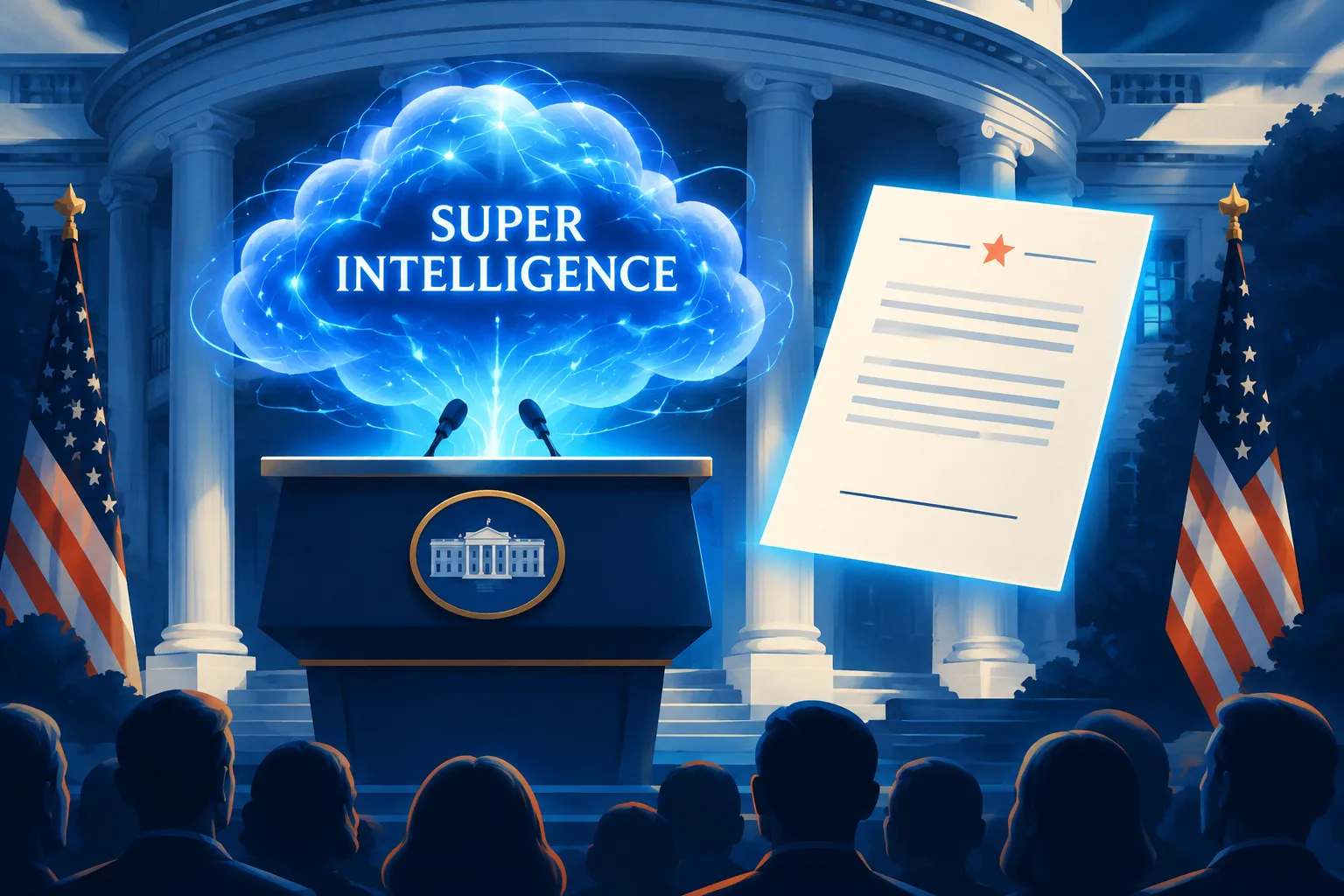
The White House is trying to change both the language and the optics surrounding artificial intelligence. President Donald Trump hosted prominent technology executives and directed U.S. government representatives to use the term “super intelligence” instead of artificial intelligence, according to a TechCrunch report published October 4.
The gathering also produced a “Joint Commitment on Frontier Responsibilities” signed by executives from major technology companies. TechCrunch’s Equity podcast team emphasized that the document is voluntary rather than legally binding. Trump described it as morally binding, but the report does not identify an enforcement mechanism or penalties for companies that fail to follow it.

That gap between ceremony and enforcement shaped TechCrunch’s analysis. Equity hosts Anthony Ha, Kirsten Korosec and Sean O’Kane questioned whether the commitment would produce meaningful changes in industry behavior. Their discussion treated the fact that the meeting happened as potentially more significant than the text of the agreement itself.
The guest list underscored the administration’s effort to assemble the industry’s most powerful figures. TechCrunch reported that Mark Zuckerberg, Jeff Bezos, Elon Musk and Anthropic chief executive Dario Amodei attended. The meeting followed a dinner involving Trump and Amodei, even as parts of the administration remained sharply critical of Anthropic, according to the discussion.
Korosec argued that the central purpose may have been a rebranding exercise. In that reading, replacing “AI” with “super intelligence” offers the administration and industry a new label at a time when public debate around the technology includes job displacement, safety and regulation. The new name does not itself resolve any of those concerns, and TechCrunch’s report offers no evidence that the terminology changes how systems are built or governed.

The speed of the initiative also invited scrutiny. O’Kane noted that the signed agreement misspelled “United States,” while Ha said the gesture appeared to have been assembled quickly. They interpreted the error and the voluntary structure as reasons to doubt that the pact, on its own, will drive major policy or technical changes.
Still, a non-binding agreement can reveal what political leaders and companies believe needs attention. The decision to pair a high-profile CEO meeting with the language of frontier responsibility suggests that safety concerns have become difficult to ignore, even for an administration that TechCrunch described as recently resistant to constraints on AI development.
For now, the clearest result is a messaging shift accompanied by a public commitment whose practical force remains uncertain. Whether the “super intelligence” label lasts, and whether the signatories translate the voluntary pledge into measurable safeguards, will depend on actions not documented in the announcement. TechCrunch’s reporting therefore points to a political signal, not proof of a new regulatory regime.
Comments
Loading comments…