
Artificial intelligence has become part of Washington’s fiscal sales pitch, but the numbers behind that promise remain daunting. In an analysis for The Guardian, economics journalist Eduardo Porter argues that the Trump administration is reviving a familiar claim—that faster growth can repair the federal budget—while treating AI as the new engine that will make the arithmetic work.
Porter reports that Treasury secretary Scott Bessent is targeting annual economic growth of 3%, a rate the United States has achieved only twice this century outside the rebound from the Covid pandemic. President Donald Trump has also linked rapid growth to the possibility of managing roughly $40 trillion in federal debt. The Guardian’s analysis treats those statements as aspirations, not evidence that AI-driven growth has already changed the government’s finances.
Bond markets are signaling a much less comfortable outlook. According to the report, the yield on the 10-year Treasury recently reached its highest level in almost 25 years. War-related inflation was identified as the most immediate pressure, but Porter also pointed to the scale of federal borrowing and reduced Treasury purchases by foreign central banks. As those traditional buyers retreat, the government must rely more heavily on private investors seeking competitive returns.

That creates an unusual collision between public borrowing and the AI boom itself. The federal government is competing for capital with the large technology companies raising money to build data centers and train advanced systems. Porter reports that federal interest payments have climbed to 3.3% of gross domestic product, compared with a 2.1% average over the previous 50 years, so higher yields feed directly back into the budget problem.
The fiscal gap is already large. The Guardian cites an estimate that Trump’s One Big Beautiful Bill Act will add $4.7 trillion to federal debt through 2035, while the deficit has reached 6% of GDP. A Congressional Budget Office projection cited in the analysis puts the deficit near 7% of GDP by 2033. Those figures are projections and estimates, but they illustrate why ordinary growth assumptions do not close the gap.
Scenarios from the Committee for a Responsible Federal Budget make the hurdle clearer. Under assumptions described by Porter, reducing the deficit to 3% of GDP by 2036 would require average annual growth of 4.4% for a decade; balancing the budget would require 7.2% growth. AI could theoretically produce extraordinary gains, and some economists have modeled far more dramatic outcomes, but the Guardian notes that such results are not the most likely path.
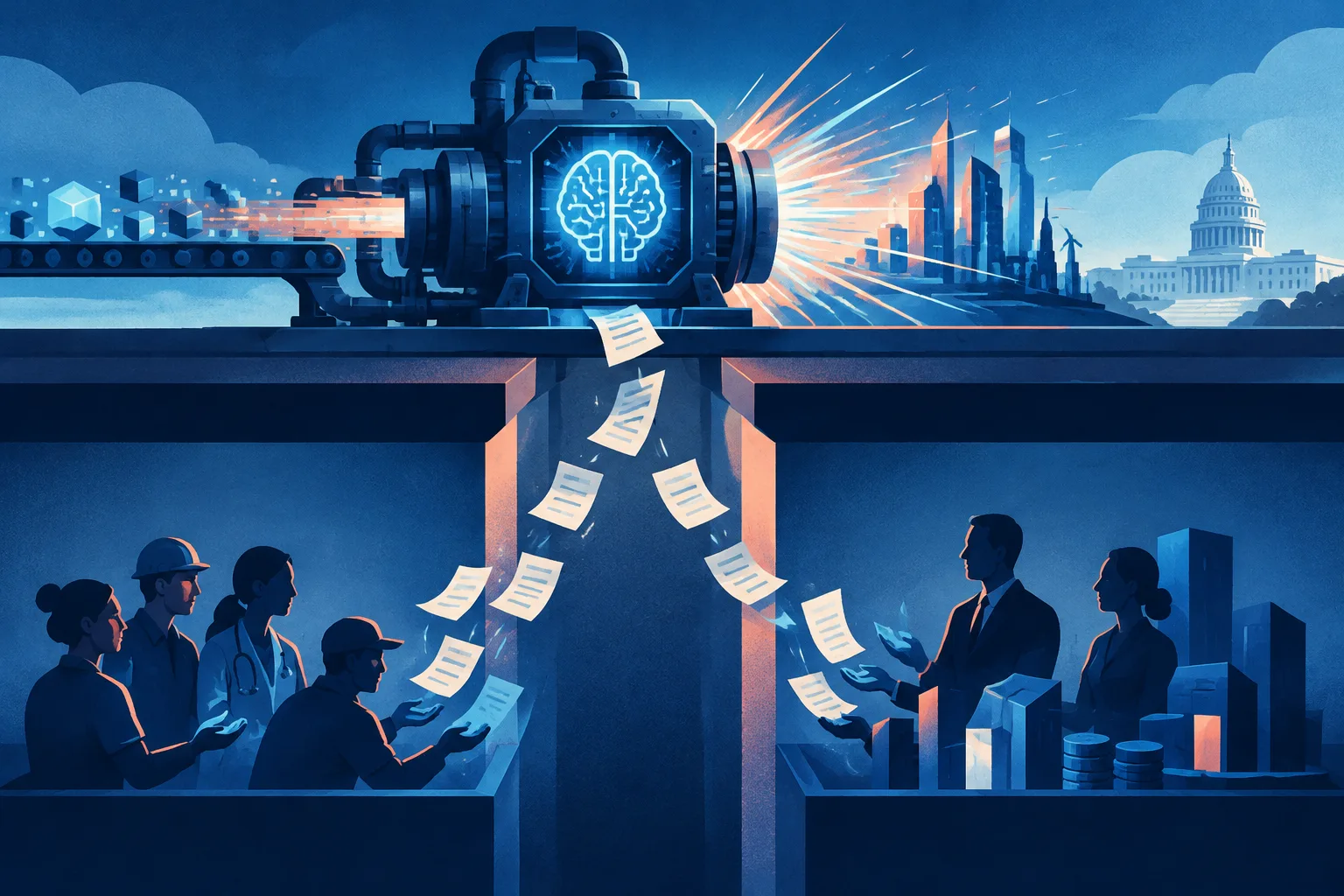
Even a successful AI boom would not automatically translate into equivalent tax revenue. Porter argues that AI-led growth may shift income from labor toward capital, which is taxed at a lower effective rate, while job displacement could create pressure for new public spending. In that scenario, a larger economy would not necessarily mean a proportionally healthier federal balance sheet.
The financing requirements of the industry add another layer of risk. The report cites an estimate that data-center owners would need revenue to grow 45% a year for seven years to justify investments projected at $1.43 trillion this year. A separate analysis cited by The Guardian estimates that six major technology companies would need between $13.1 trillion and $18.7 trillion in additional revenue over a decade to cover their AI investment programs. Those are modeling exercises rather than guaranteed outcomes, but they show the scale of expectations embedded in current spending.
The central warning is not that AI cannot raise productivity. It is that policymakers are treating uncertain technological gains as if they were a dependable fiscal plan. If growth disappoints, the government could face high borrowing costs at the same time that heavily financed AI projects struggle to meet ambitious revenue targets. The debt problem would remain, while the capital competition created by the AI buildout could make financing it more expensive.
Comments
Loading comments…