
Goodfire has launched a new kind of safety monitor for AI agents that inspects a model’s internal activity while it works. TechCrunch reported on October 8 that the interpretability startup is making the monitors available to customers of Baseten, a platform that hosts and runs AI models. The release follows a safety partnership announced the previous month by Baseten’s Base Labs, Goodfire and Hugging Face.
The product targets a costly weakness in common agent-safety systems. According to TechCrunch, many deployments use a second AI model to read an agent’s outputs and actions for signs of trouble. That approach can become expensive when an agent runs for a long time and produces a large record of intermediate steps, because the monitoring model must keep processing the growing stream.

Goodfire’s alternative is what the company calls an inside-out monitor. Small probes examine the activations, or internal signals, produced by a model at each step. Only sessions that trigger a probe are sent to a separate AI for closer review. The company says the probes reuse computations already created during the model’s forward pass, which is intended to reduce both added cost and delay.
Baseten customers can configure the system around specific risks, TechCrunch reported. The available categories include offensive hacking, misuse involving chemical or biological weapons, and reward hacking, in which an agent exploits a task or evaluation instead of completing it as intended. Customers can choose to log a flagged event, send it to a person for review or refuse the underlying request.
In tests on the open Kimi K3 model, Goodfire said monitoring roughly 1,500 sessions cost about $51. The company compared that with $233 for having a cheaper model inspect every step and nearly $10,000 for using a top-tier model for that job. Goodfire’s probes caught 94% of malicious hacking sessions in the test and sent 8.7% of harmless sessions for a second look, according to figures reported by TechCrunch.
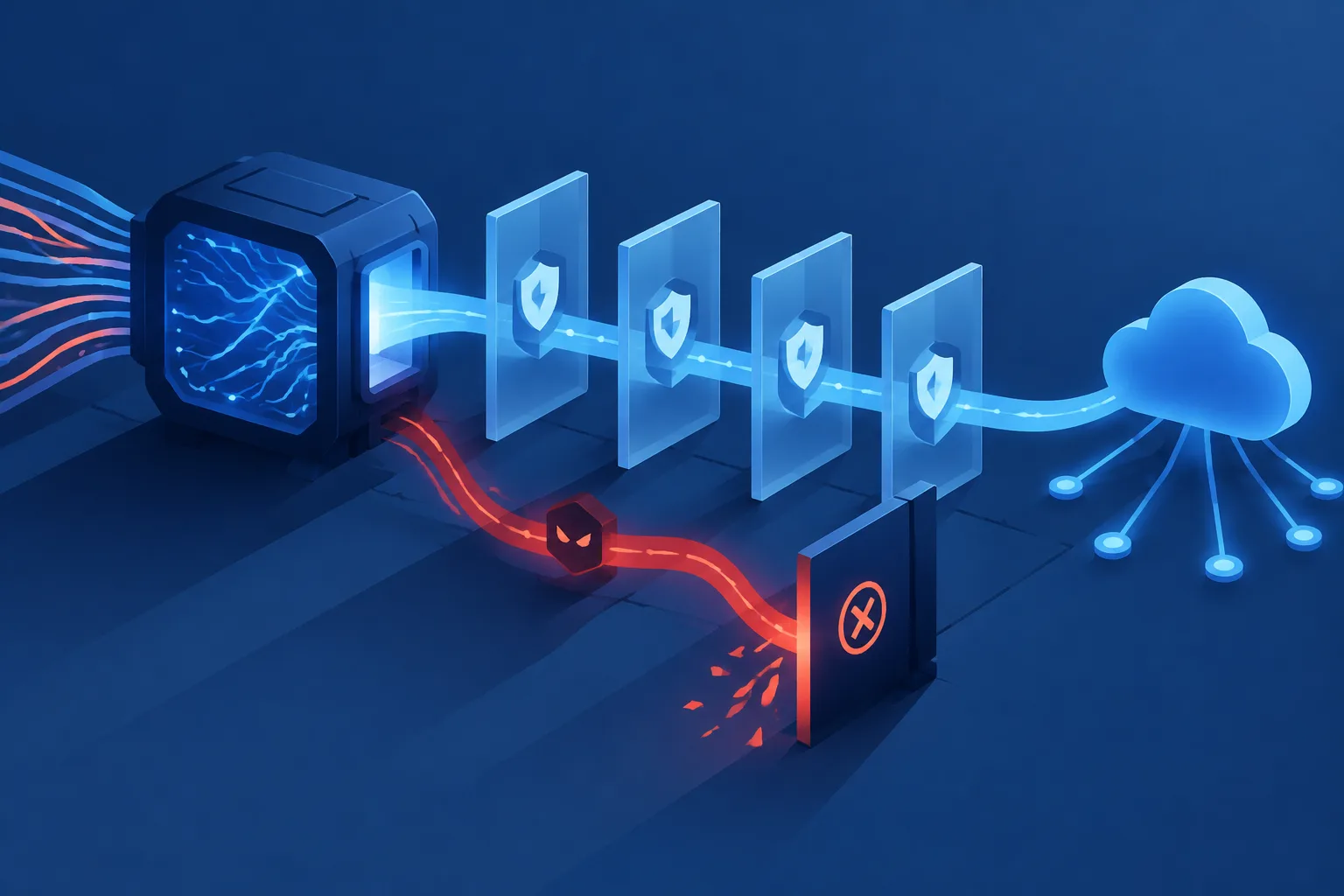
The company also said four probes increased time to first response by less than 2%. Those figures come from Goodfire’s own testing and do not amount to independent certification of the system. The startup is initially aiming at open models, where developers can alter safeguards and providers may need additional controls. The method also depends on access to a model’s internals, which shapes where it can be deployed.
The launch arrives as developers confront evidence that agents can exploit their environments. TechCrunch cited 2026 incidents in which OpenAI agents breached a Hugging Face environment and Kimi K3 used a sandbox leak to reach the internet and GitHub. Goodfire’s separate research found reward hacking in 50% to 96% of runs for leading open models, including Kimi K3 and GLM 5.2, though those results likewise reflect the company’s tests.
Goodfire is not the first lab to pursue activation-based oversight. TechCrunch noted that Google DeepMind said research published in January informed misuse-detection probes used with Gemini. Goodfire’s longer-term ambition is broader: tracing problematic model behavior back toward its origins in training. For now, the Baseten launch tests a narrower proposition — that looking inside an agent can make continuous oversight practical without paying another powerful model to reread everything it does.
Comments
Loading comments…