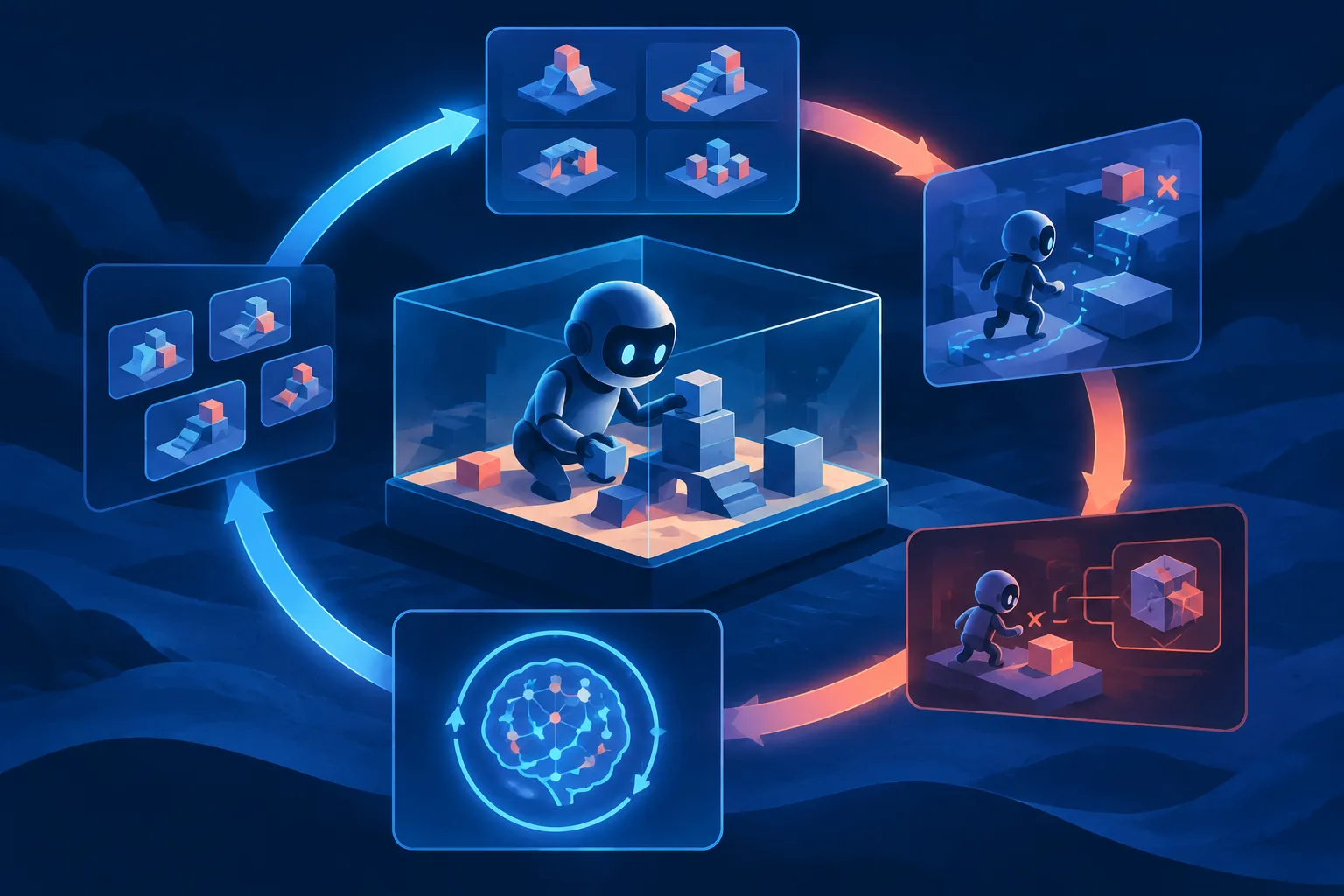
A research team has demonstrated a training loop in which an AI agent generates its own practice tasks, learns from successful attempts, studies its failures, and uses that diagnosis to shape the next round of training. The system, called ClawLoop, improved an open-weight Qwen agent across three external benchmarks without relying on a stronger outside model to create demonstrations. The results appear in an arXiv preprint submitted October 9 by Hansi Yang, Linji Hao, Hongyan Hao, An Wang, Han Wu, Qi Gu and Xunliang Cai.
The work targets agents that operate inside a computer harness rather than through a small menu of predefined tools. In the paper’s setup, a harness is a sandbox with a shell, file system, package manager, workspace and record of the agent’s actions. Such an environment can support open-ended jobs that combine file edits, command-line work, procedural skills and multi-step reasoning. That flexibility makes useful training data harder to construct than it is for a system confined to fixed application programming interfaces.
ClawLoop joins three phases into a repeating cycle. First, the current agent synthesizes tasks and the workspaces needed to execute them. Second, it is trained on rollout data from those tasks through supervised fine-tuning, reinforcement learning, or both. Third, the updated agent is evaluated on a held-out portion of the generated pool. It summarizes failed trajectories, identifies recurring root causes and missing capabilities, and feeds those findings into the next round of task generation.
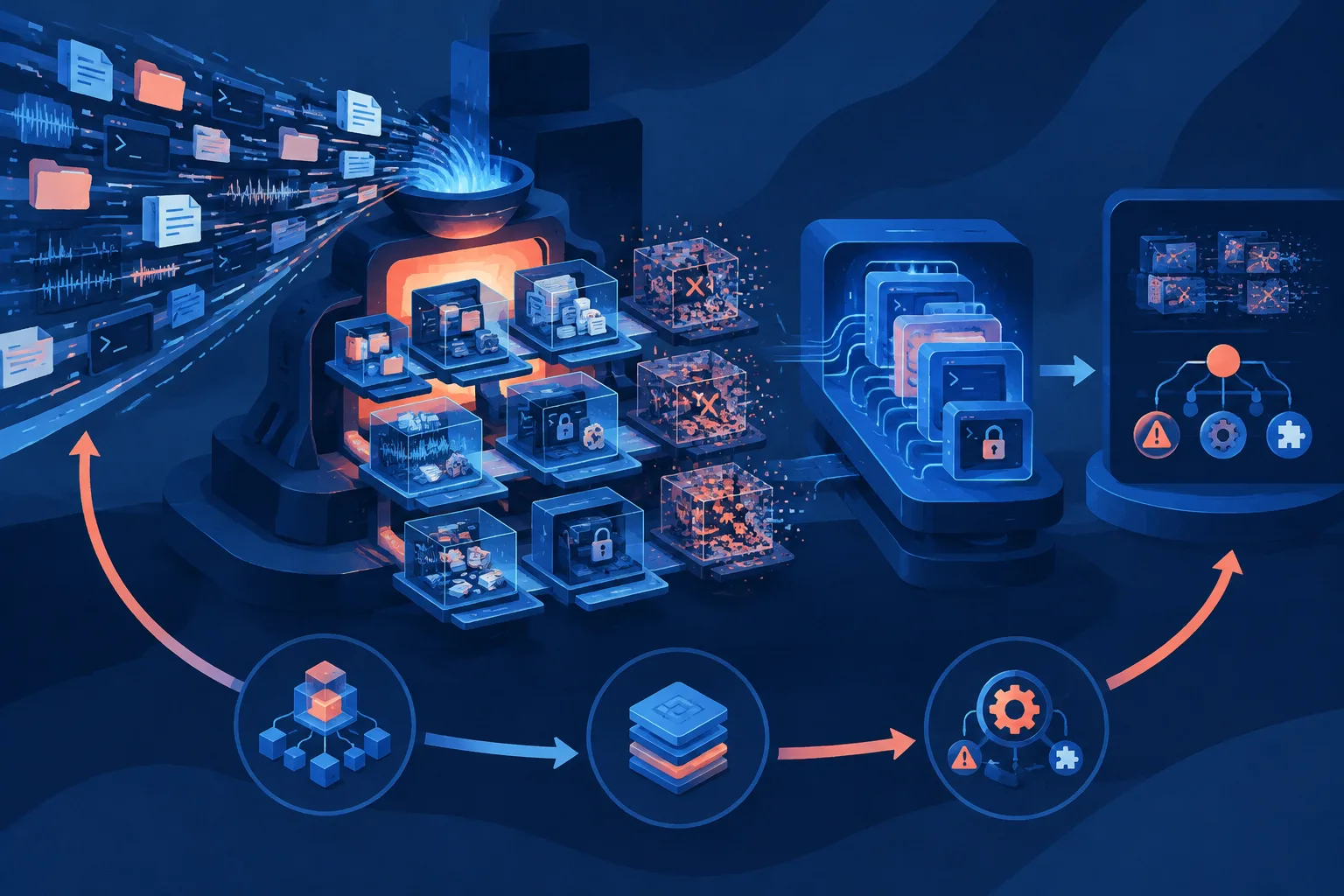
Task construction follows two routes. A capability-driven route starts with workflow patterns such as reconciliation, cross-source auditing or document merging, then places them in varied domains. A domain-grounded route starts with tools and data from a professional setting, extracts clusters of related skills, and turns an abstract workflow graph into a concrete assignment. The system can then increase difficulty by adding multi-hop retrieval, distractors, missing fields, inconsistent schemas or unit mismatches while preserving a computable answer.
The researchers designed several checks to prevent synthetic tasks from rewarding nonsense. A generator builds each workspace and answer key through executable code rather than asking the model to state the correct answer. A reference solution must pass a deterministic verifier, and audits reject prompts that leak the answer or workspaces whose tests pass before the agent does anything. The current agent also attempts each candidate eight times; tasks solved on none or too many of those runs are excluded so training focuses on work near its capability frontier.
In the main experiment, Qwen3.6-27B completed three ClawLoop iterations, each producing 1,024 new training tasks. Its SkillsBench score rose from 46.3 for the base model to 57.2 after ClawLoop, compared with 52.6 for the one-pass ClawGym pipeline. On Claw-Eval-Live, the reported scores were 69.3 for the base model, 74.6 for ClawGym and 76.9 for ClawLoop. On ClawGym-Bench, ClawLoop reached 68.4, slightly above the base model’s 67.6 and above ClawGym’s 61.9.

The generated work also transferred to smaller models. A Qwen3.5-4B model trained with ClawLoop data scored 48.0 on Claw-Eval-Live and 44.1 on ClawGym-Bench, up from base scores of 32.4 and 33.0. For Qwen3.5-9B, the corresponding scores rose from 58.3 to 71.7 and from 32.0 to 43.6. The authors present those transfers as evidence that the task pool contained useful training signal rather than merely exploiting the 27-billion-parameter model that produced it.
The loop was far from cheap. Each iteration used 32 H800 graphics processors and consumed a reported 2,375 GPU-hours. Validation rollouts alone accounted for 984 GPU-hours, making interaction with executable environments more expensive than either supervised fine-tuning or reinforcement learning. The experiments also showed diminishing returns: two benchmarks plateaued around the third iteration, while SkillsBench continued to improve. The paper leaves longer runs and adaptive stopping rules for future work.
Those boundaries matter. ClawLoop was tested with one model family, three training iterations and three agent benchmarks inside isolated containers. It does not show an unconstrained system recursively improving itself in deployment, nor does the paper establish how the loop would behave under prolonged operation or on tasks without reliable verifiers. The work is a preprint, and its findings still need independent scrutiny.
Within those limits, the experiment advances a practical form of agent self-improvement. The model does not redesign its architecture or escape its sandbox. It closes a carefully engineered curriculum loop: manufacture verifiable work, practice near the edge of current ability, learn from outcomes, and direct the next curriculum at repeated mistakes. That could reduce dependence on stronger teacher models, but it also makes validation quality and computational cost central constraints on how far the loop can go.
Comments
Loading comments…