
The economics underpinning the AI datacenter buildout are facing a new challenge: models are becoming cheaper to run at the same time that cloud companies are committing extraordinary sums to new capacity. The Register reported on October 13 that Jefferies is questioning whether lower-cost Chinese, open-weight, and small language models could force a reset in the financial assumptions supporting the boom.
In a research note focused on Asian markets, Jefferies estimated that Microsoft, Alphabet, Amazon, and Oracle have roughly $2.3 trillion in contracted backlog. The analyst said OpenAI and Anthropic account for about half of that total. That concentration matters because the future revenue expected from enormous infrastructure investments may depend heavily on a small number of model providers continuing to purchase compute at high volume and attractive prices.

The competitive pressure is visible in usage figures cited from OpenRouter. Chinese models processed 76.12 trillion tokens during the week ending September 27, up from 4.37 trillion in late April, according to the report. The four largest US providers processed 14.2 trillion tokens during the same September week. Those figures come from one aggregation platform rather than the entire market, but they illustrate how quickly lower-cost alternatives have gained activity within that ecosystem.
Jefferies also pointed to Moonshot AI’s open-source Kimi K3. The firm estimated that the model delivers about 95 percent of the performance of Anthropic’s Claude Fable 5 while competing near the frontier. The Register’s report did not describe the benchmark behind that estimate, so the percentage should be treated as Jefferies’ assessment rather than a settled cross-model measurement.
The concern is not simply that new models will attract users. Lower-priced competition can compress the amount providers earn for each token, even as models become more widely used. Jefferies described an ongoing collapse in token pricing and questioned whether large language models can become reliably profitable under those conditions.
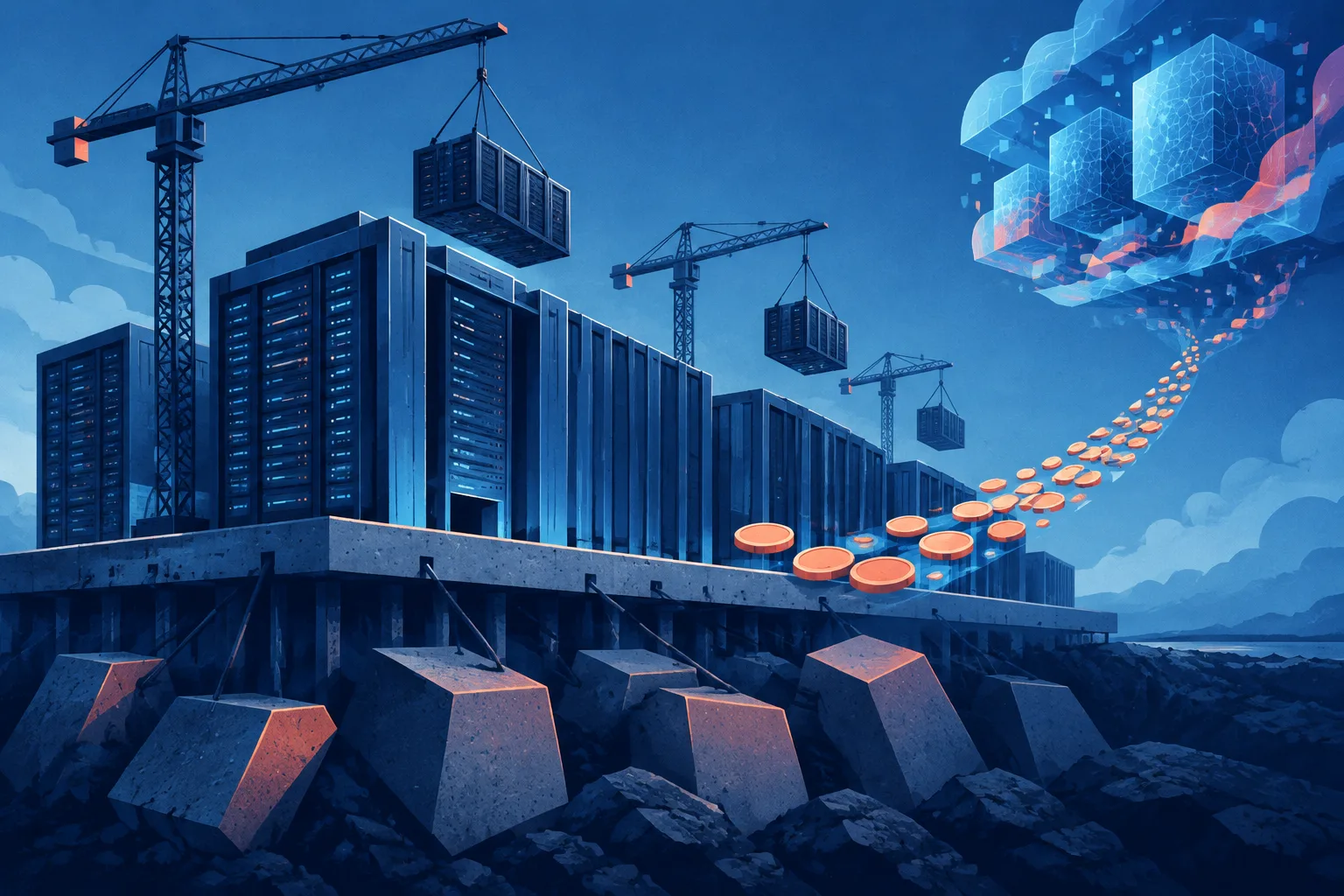
That uncertainty collides with the scale and financing of the buildout. Jefferies expects the largest hyperscalers to spend a combined $600 billion to $800 billion on datacenters this year. According to The Register, a growing share of that construction is being financed with debt rather than cash. If future compute revenue falls below the assumptions used to justify those projects, the financial pressure would extend beyond model developers to cloud platforms and their capital providers.
The research note is a warning, not proof that the investment cycle will fail. Contracted backlog is not the same as realized revenue, while token volumes on one platform do not establish the profitability of every provider or workload. Premium models may also retain pricing power for tasks where quality, reliability, or specialized capabilities outweigh cost. The report does not quantify how much demand would have to shift before infrastructure projects become uneconomic.
Still, the analysis identifies a structural tension in the AI market. The supply side is being built around long-lived, expensive facilities, while the software running inside them is exposed to rapid cost declines and aggressive global competition. If capable models continue getting cheaper, the industry’s central question may move from whether enough compute can be built to whether that compute can earn enough money once it comes online.
Comments
Loading comments…