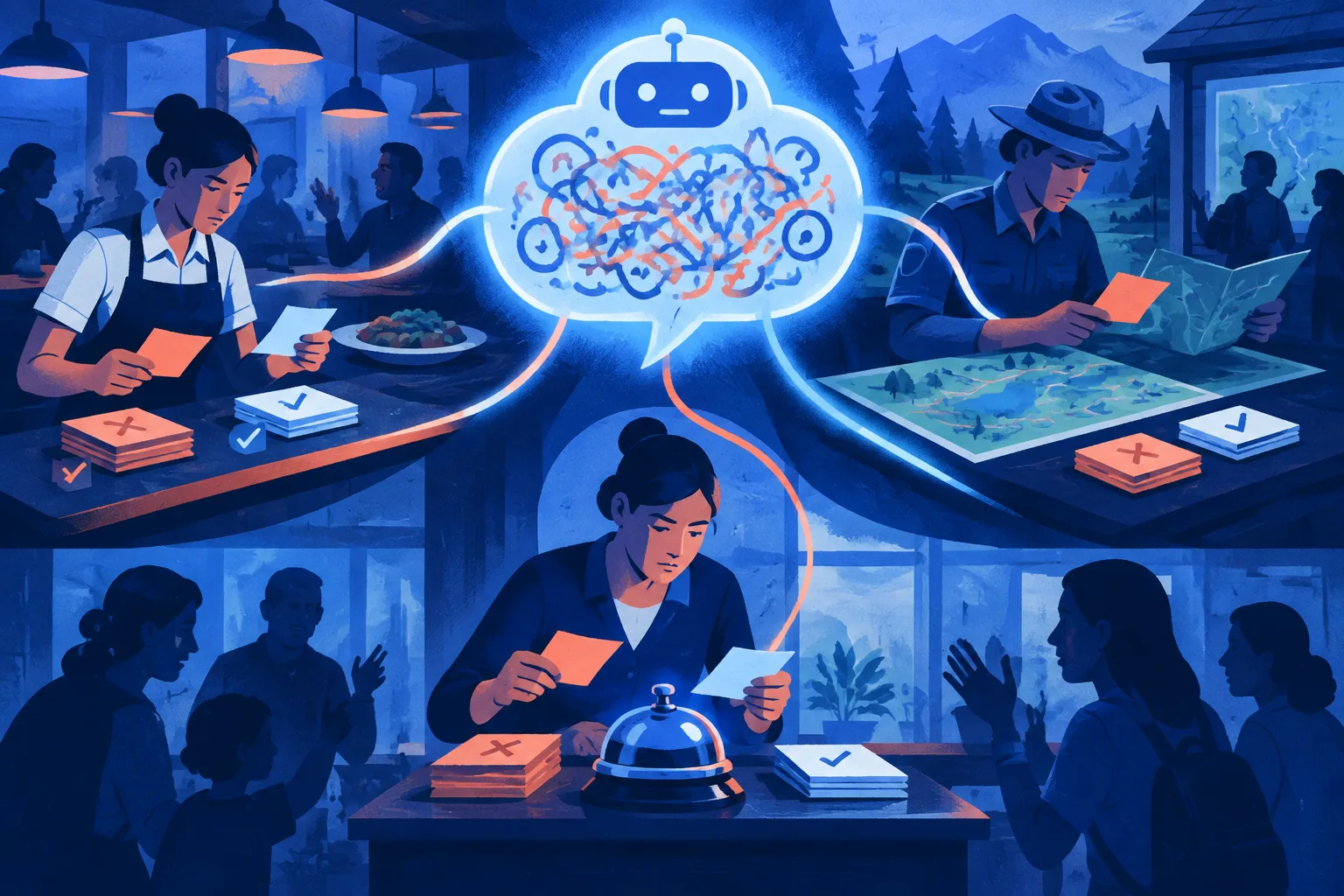
Generative AI is creating a new kind of customer-service burden: workers are not only answering questions, but also correcting information that a chatbot supplied with unwarranted confidence. In an October 2 report, The Verge documented the pattern across restaurants, public lands, childcare programs, retail, and event bookings.
At a New York restaurant, a server identified as Madison said some diners have relied on ChatGPT even after staff warned that a dish conflicted with a stated food allergy. She described a customer with a shellfish allergy considering a fish dish whose broth contained shellfish, then resisting the restaurant’s warning because the chatbot had offered different information. The account illustrates how a fabricated answer can move beyond inconvenience when a health risk is involved.

The same reliance appears in lower-stakes choices. Madison told The Verge that diners have dismissed offers to consult a sommelier and instead asked ChatGPT for wine advice. Some then requested bottles the restaurant did not carry, including names that did not exist. Staff sometimes softened the correction by explaining the limits of the restaurant’s list instead of bluntly saying the chatbot had invented a product.
The problem extends far beyond dining rooms. A federal river ranger using the pseudonym Jason said visitors have arrived with AI-generated itineraries containing fictional campsites or routes arranged in an impossible order, at times requiring travelers to row upstream. He said some groups remained doubtful even while rangers used maps and printed guides to explain why the plan could not work.

In an after-school program, a teacher identified as Casey reported that parents and caretakers increasingly consult ChatGPT or Claude about childhood development. In one case, Casey believed a child’s behavior showed a need for two to three additional hours of sleep each night. The parents continued to defend a schedule recommended by ChatGPT, according to her account.
AI agents can add another layer by communicating directly with businesses. Lauren Wilford, a longtime food-service worker, said her Providence restaurant now receives calls and emails from agents seeking reservations for users. Before one large event, a client account suddenly sent late requests for podiums, audiovisual equipment, and catering changes. Wilford suspected an AI agent generated those requests because the guests did not mention them when they arrived, but she could not prove that explanation.
The Verge also heard from movie-theater workers, baristas, and Apple Store employees who said customers had asked for nonexistent products or features. These are reported experiences rather than a measurement of how common the problem is. Taken together, however, they show a practical cost of unreliable AI output: the people closest to the menu, map, child, product, or venue must spend additional time restoring shared facts before ordinary service can continue.
Comments
Loading comments…