
A fleet of autonomous balloons feeding observations into an artificial-intelligence weather model has won a potentially large new customer. TechCrunch reported on October 12 that the U.S. Air Force awarded WindBorne Systems a contract worth as much as $49 million for atmospheric data collected by the company’s balloon network. The agreement gives the military a vehicle for buying information from particular regions and at particular times, while also supporting further expansion of the system.
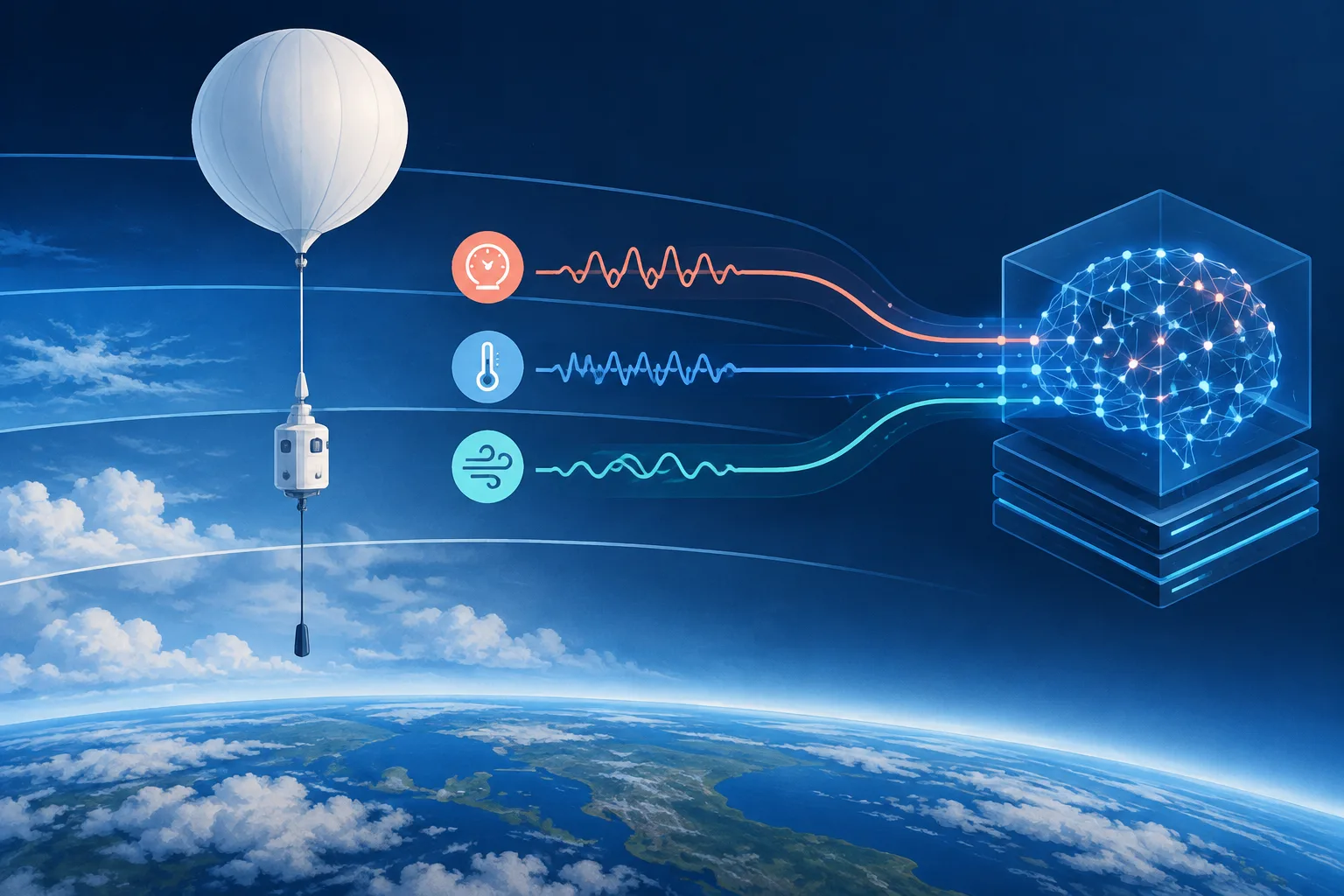
WindBorne, founded in 2015 and based in Redwood City, California, currently operates about 700 balloons around the world, according to the report. Their sensors gather atmospheric readings that the company sells to customers and uses in its own forecasting model. TechCrunch described WindBorne as one of the first organizations to feed directly observed weather data into a deep-learning forecast system, linking physical collection hardware with the models trained to interpret it.
The headline value is a ceiling, not money already committed. The Air Force pays when it orders data, and it has placed orders totaling $1.7 million so far. WindBorne executives told TechCrunch they expect additional orders, but the eventual value will depend on how much information the service actually requests. That distinction makes the contract a significant procurement channel without guaranteeing that the full $49 million will be spent.
The award was made without competitive bidding. WindBorne co-founder and chief technology officer Andrey Sushko told TechCrunch that the government determined the company was the only provider able to deliver this kind of global collection capability in the required way. He said the contract would help support growth of the balloon constellation as well as research and development intended to improve the balloons’ hardware and performance.
The deal follows a year of rapid expansion for the startup. Chief executive John Dean told TechCrunch in August that WindBorne had raised a $37 million Series B round. Earlier in the summer, the company released WeatherMesh 6, the latest version of its forecasting model. WindBorne says that model is more accurate than the traditional physics-based system operated by the European Centre for Medium-Range Weather Forecasts, though the report presents that comparison as the company’s claim.

AI forecasting has advanced as transformer-based architectures have spread and the European weather center has made a large historical dataset available. Instead of relying only on supercomputers to solve detailed equations describing atmospheric behavior, learning systems can process decades of observations and generate predictions more quickly. TechCrunch noted that models from government agencies and leading AI laboratories have beaten conventional forecasts in some comparisons, while emphasizing that performance remains uneven and that both approaches are still needed for useful weather analysis.
WindBorne’s balloons are not powered aircraft. The company guides them by changing altitude, releasing air, or dropping sand ballast so that they enter winds moving in the desired direction. In August, WindBorne became the first organization to send an unpowered flight system into the eye of a typhoon to collect data, according to the report. Sushko attributed that result to better wind models and a constellation large enough to place balloons where changing conditions could carry them toward the storm.
The Air Force agreement therefore tests more than a forecasting algorithm. It joins an AI model to a distributed sensor network and a military purchasing mechanism that can direct collection toward specific places. If orders grow, the arrangement could finance denser observations and further model development; if they do not, the large ceiling may remain mostly unused. For now, the clearest result is that an AI-native weather company has moved from experimental capability into an operational procurement channel, with the scale of deployment still uncertain.
Comments
Loading comments…