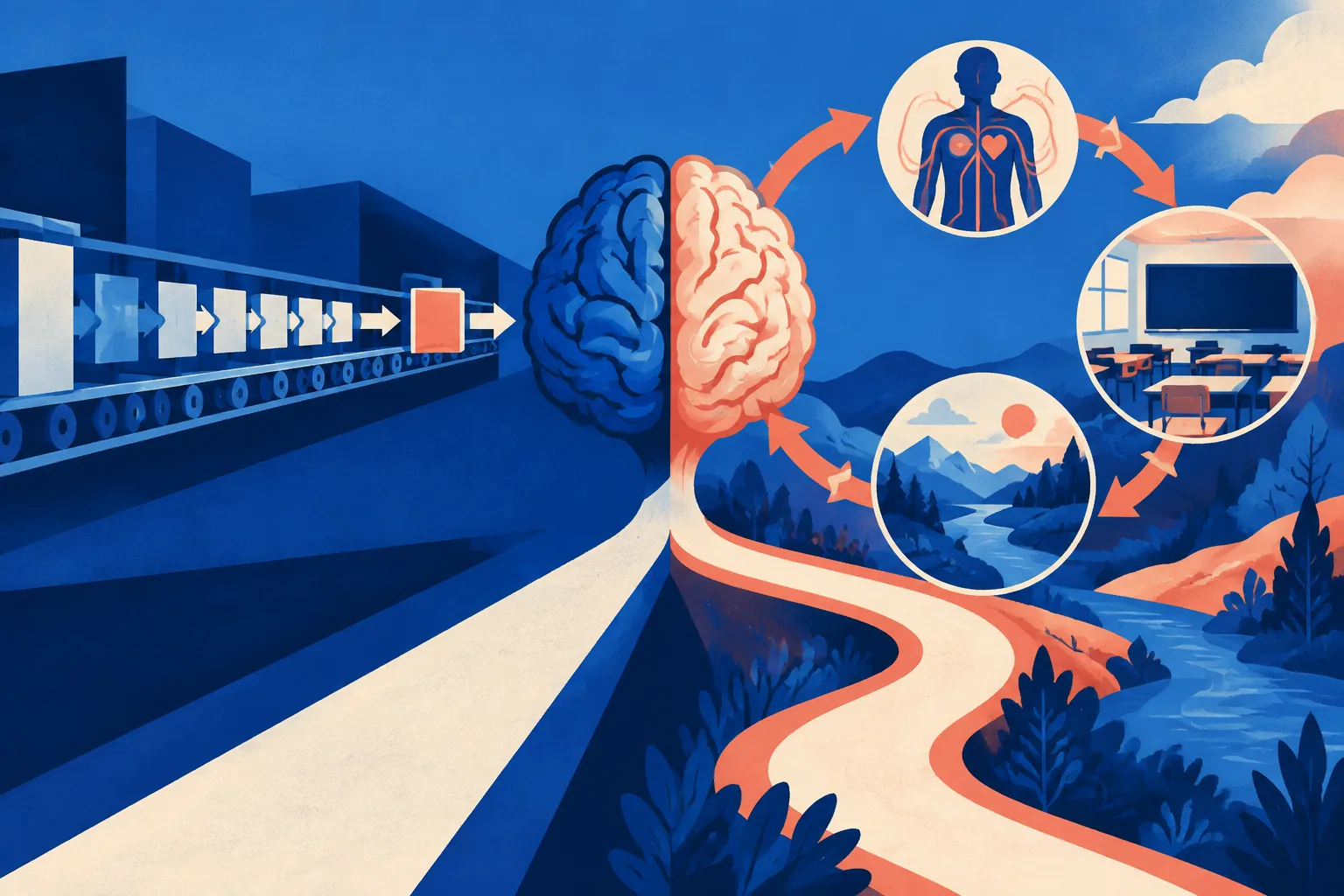
A new essay in The Verge argues that the debate over artificial intelligence in education begins with a flawed metaphor: the idea that a human mind works like a computer. Benjamin Riley writes that this input-computation-output model overlooks the way cognition is embedded in bodies, environments and social institutions. His conclusion is deliberately provocative: frequent AI use can become the mental equivalent of junk food—convenient in the moment but damaging when it replaces the effort through which people build durable knowledge.
Riley traces the computational view of thought to Alan Turing and describes its familiar sequence: perception supplies an input, cognition processes it and action follows as an output. The model has been productive for computer science, he acknowledges, helping technologists build increasingly capable machines. But he argues that it offers only a partial account of people because it focuses on the apparent products of thought while separating mental activity from physical movement and the world in which that activity occurs.
As an alternative, the essay draws on University of Montreal neuroscientist Paul Cisek's view of brains as feedback-control systems. Riley illustrates the distinction with an outfielder catching a fly ball. A purely computational account suggests the player unconsciously calculates the ball's path. A feedback-control account offers a simpler process: keep the ball in the same place in the visual field and move continually to maintain that relationship. Action changes the next sensory input, creating a loop rather than a one-way pipeline.

The essay extends that loop across evolutionary time. Riley summarizes Cisek's argument that new neural structures and behaviors emerged as organisms encountered new possibilities in their environments. He points to navigation and episodic memory as capacities connected to the development of the hippocampus. In this framing, brains do not merely transform information; they help living organisms expand and adjust their control over surroundings.
Human cognition is also social, Riley argues. Imitation, spoken language, writing and formal education allowed communities to preserve and transmit knowledge across generations. Markets, law and democracy similarly became collective systems for coordinating decisions. The essay presents these cultural institutions as continuous with biological evolution: both broaden the ways people can act on the world, while also creating new vulnerabilities when convenience displaces practices that cognition depends on.
That is where Riley's food metaphor enters. Humans evolved to value calorie-dense food when it was scarce, but abundance changed the risk. He argues that AI creates an analogous temptation by automating cognitive work that people need to perform in order to learn. Occasional use is not his central concern. The danger, in his account, comes when delegation to a model becomes a regular part of a person's mental diet and crowds out active reasoning.
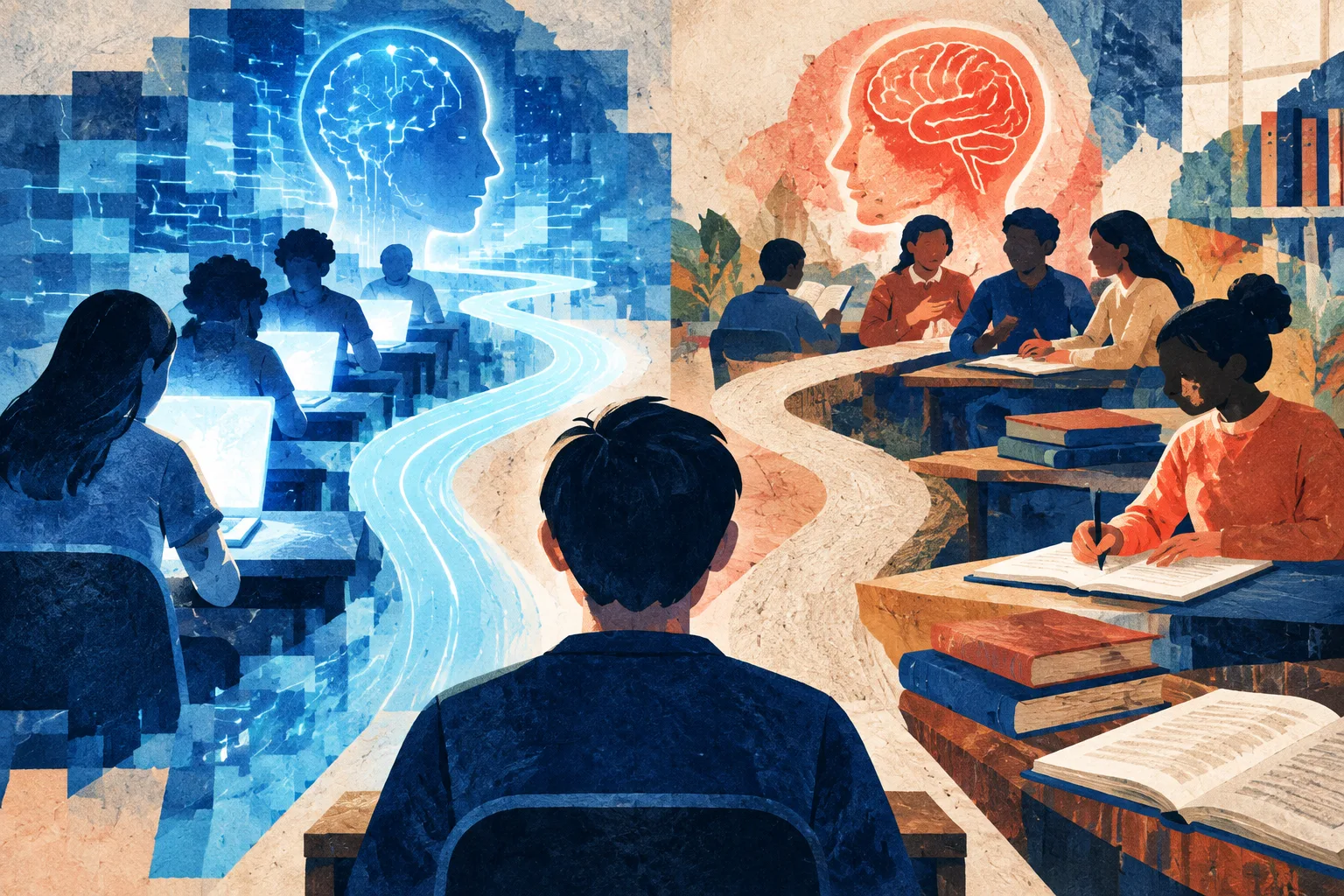
Education is the essay's main test case. Riley cites a July 2025 podcast in which OpenAI education vice president Leah Belsky said learners represented more than half of ChatGPT's 900 million average monthly users and described the service as the world's largest learning platform. He also notes Anthropic's Claude for Teachers initiative, which offers educators access to premium models. Riley interprets those programs not as neutral tools but as efforts to place cognitive automation inside institutions responsible for developing human judgment.
To support that warning, Riley links to research and reporting on students using AI to avoid difficult work, reduced learning after reliance on AI assistance and weaker judgment outside the original task. He highlights one study from China that, as he summarizes it, found thousands of students largely stopped doing homework after gaining access to AI, with learning suffering as a result. The Verge article is an argumentative synthesis rather than a controlled experiment of its own, so those linked findings vary in method and scope and do not by themselves establish one universal effect for every classroom or use case.
Riley also invokes recent work on cognitive delegation, which warns that widespread outsourcing of thought can weaken the social environment supporting autonomous reasoning and make further delegation more attractive. The proposed response is described as cognitive immunization: preserving unaided problem-solving, verification, critical discussion and deliberate periods away from AI. Riley's point is that schools already exist to organize precisely those practices, making their role more important rather than less important in an AI-saturated environment.
The essay ends with a policy argument. Riley points to Norway's near-ban on school AI use for children under 13, a major US teachers' union calling for elementary-school chatbot restrictions, and recent classroom bans in Los Angeles and New York City. He discloses that he informally advised an organization that advocated for those bans. Whether policymakers accept his prescription or not, the piece reframes the issue: the question is not only whether an AI answer is accurate, but whether repeated reliance on the system changes the human capacity to reason without it.
Comments
Loading comments…