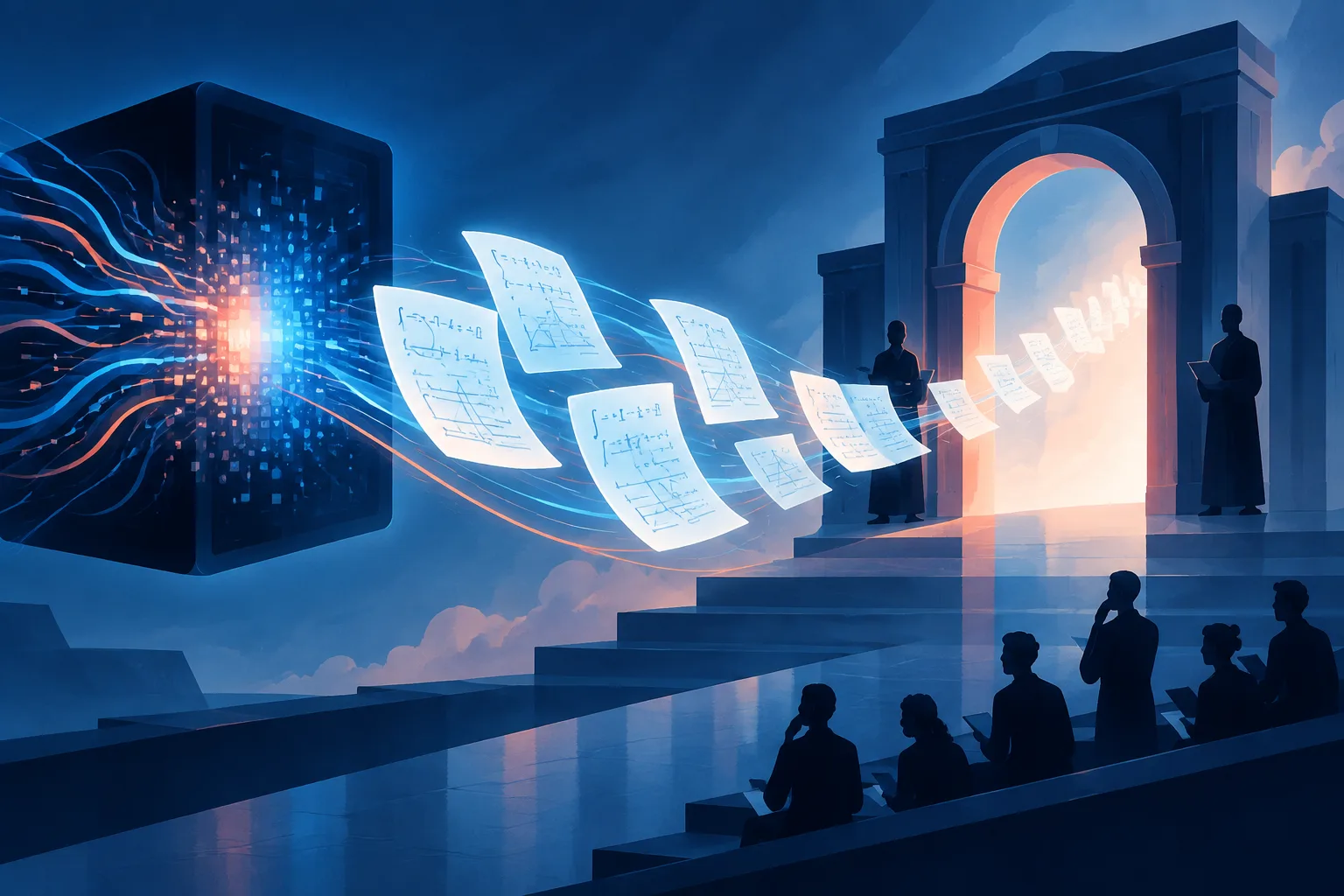
OpenAI’s claim that an internal model has resolved more than 100 long-standing mathematical problems—and even the Navier–Stokes Millennium Prize problem—has sharpened a dispute over how artificial-intelligence companies should present discoveries that have not yet passed through conventional academic review. According to WIRED, the company is preparing to release a large collection of results, but it has not set a public timetable.
The disagreement is not simply about whether an AI system can produce valuable mathematics. It concerns the evidence required before a result should be treated as a breakthrough, the time independent experts need to check it, and the credit owed to researchers whose earlier work may have shaped the model’s answer. Those questions become more urgent when a company can announce hundreds of claimed solutions at once.

WIRED reported that OpenAI convened roughly 40 mathematicians in August to discuss the possibility that AI systems could move beyond human capabilities in parts of the field. Attendees said the company indicated that its models had solved hundreds of open problems and asked for advice about publication. The mathematicians urged OpenAI to provide papers that explain the work, rather than relying on blog posts or social-media announcements.
An OpenAI spokesperson, Lindsay McCallum, told WIRED that a model trained beginning August 28 had allegedly resolved the Navier–Stokes problem and more than 100 other long-standing questions. Those are company claims, not independently established findings. McCallum said OpenAI was working on a responsible release with guidance from an advisory group based at the Institute for Advanced Study, while also saying that no release time had been fixed.
The verification challenge is substantial. In mathematics, a result becomes useful only when specialists can inspect the argument, test every step, compare it with prior literature, and determine whether the claimed advance is genuinely new. A repository of outputs may make material available quickly, but availability is not the same as validation. Several academics interviewed by WIRED argued that standard processes for verification and attribution were being bypassed.

The tensions also follow a September dispute over credit. Mathematician Tristan Buckmaster accused OpenAI of getting ahead of unpublished work related to a problem he had developed with Anthropic employee Levent Alpöge, whose research used OpenAI tools. OpenAI researcher Sébastien Bubeck denied asking that Alpöge be excluded as an author. The competing accounts leave the episode contested, but they illustrate why disclosure about sources, collaborators, and model-assisted steps matters.
Some mathematicians are building infrastructure for that new environment. WIRED pointed to Hexagon, a repository focused primarily on AI-generated mathematical material, and Palomar, a registry for machine-verified mathematics. More than 4,000 mathematicians have also signed the Leiden declaration, which calls on AI companies to follow established standards in mathematical research. These efforts suggest the field is not rejecting AI-generated work; it is trying to make such work auditable.
OpenAI told WIRED that it is collaborating with mathematicians and does not consider the future of mathematics settled. Bubeck argued that stronger systems could help researchers pursue more ambitious questions, connect abstract mathematics to real-world problems, and broaden access to the discipline. Even critics acknowledge that research practices will have to adapt. The immediate test is whether OpenAI’s eventual release provides enough detail, provenance, and room for independent scrutiny to turn extraordinary claims into mathematics that others can trust and build upon.
Comments
Loading comments…