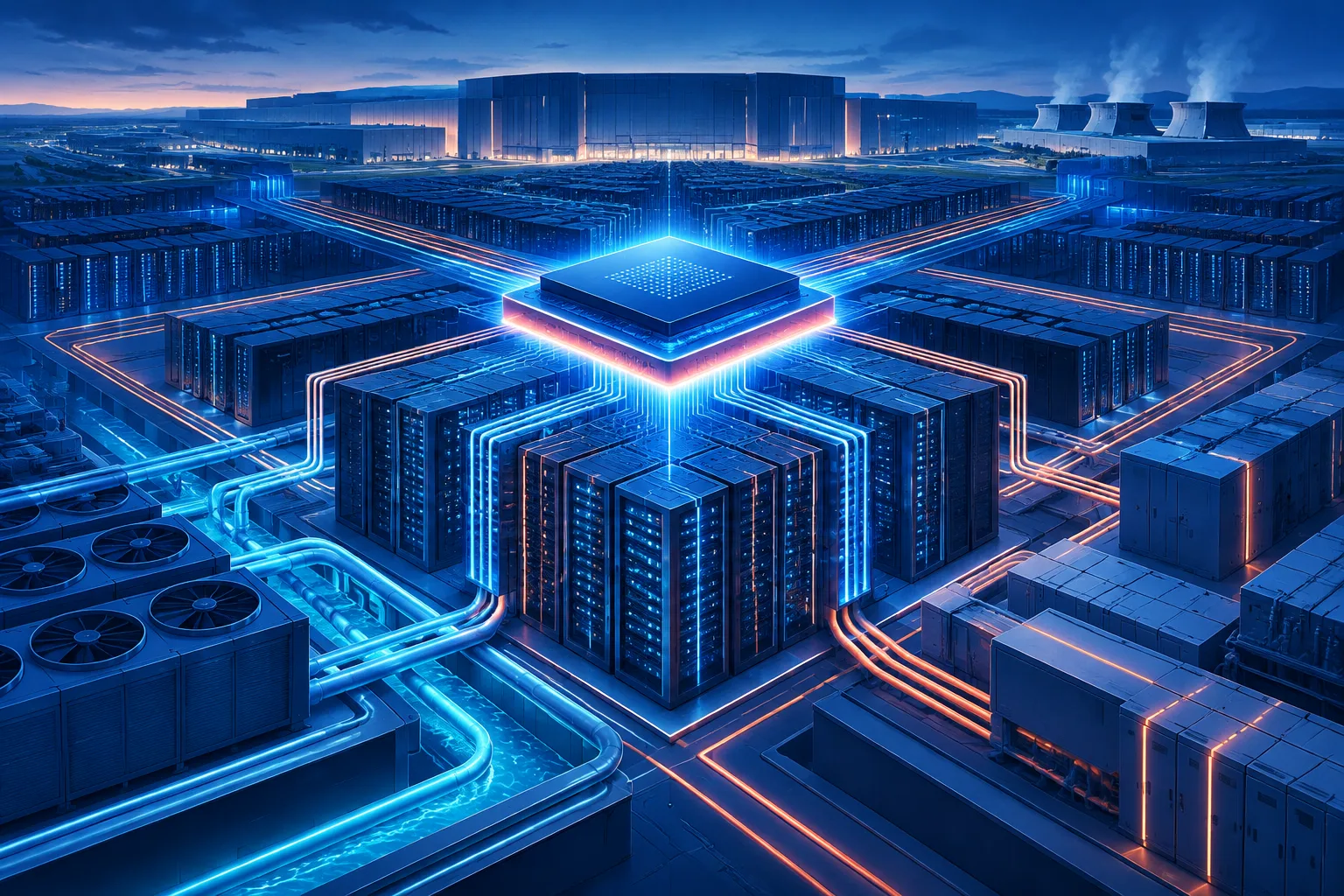
Microsoft is preparing to scale its next generation of custom AI infrastructure into multi-gigawatt deployments beginning in 2027, according to a report from The Register published October 13. The plan centers on Azure Maia 300, a successor to the Maia 200 accelerator that Microsoft says is already handling production workloads. Rather than presenting the new chip as a standalone component, the company is describing a tightly integrated computing system built for increasingly demanding AI inference.
The proposed rack design would combine as many as 96 Maia 300 accelerators. Microsoft claims that a full configuration could deliver up to seven times the rack-scale token throughput of Maia 200 and produce 40% more tokens per megawatt than leading systems based on graphics processors. Those figures are vendor claims and have not yet been independently demonstrated in the deployment described by the report, which is not due to enter production until 2027.

Memory is a central part of the design. Each accelerator is expected to use eight stacks of HBM4 high-bandwidth memory and provide as much as 18 terabytes per second of peak memory bandwidth. Microsoft says the architecture is optimized first for inference, particularly long-context, memory-heavy and decode-intensive workloads. Those are the kinds of tasks that become more important when an AI system must retain extensive context, call tools and complete a sequence of steps rather than answer a single prompt.
Microsoft’s larger argument is that agentic inference changes the shape of the workload enough to require co-design across the entire datacenter. The company says Maia 300 will integrate software, silicon, rack hardware, networking and datacenter infrastructure as one platform. That approach resembles the rack-scale systems Nvidia has developed around its accelerators and the Helion and Helios infrastructure introduced by AMD, The Register noted.
The scale of the commitment is as significant as the architecture. A multi-gigawatt deployment is not simply a larger order for chips; it points to a long-term infrastructure program in which energy efficiency, networking and physical design become inseparable from model performance. Microsoft’s claim of higher token output per megawatt shows how power has become a core competitive metric as cloud providers try to expand AI capacity without letting electricity demand erase their gains in computing throughput.

The strategy also marks a contrast with Microsoft’s public posture in 2024. Its AI Access Principles emphasized partnerships across the technology stack, and the company complained to European competition authorities that Google’s vertical integration gave it strength and independence at every layer. Microsoft now has custom AI accelerators, its own rack-scale designs and internally developed MAI models, giving it more direct control over many of the same layers it once highlighted as a rival’s advantage.
That shift does not mean Microsoft is abandoning outside suppliers or partnerships, and the report does not establish how much of Azure’s future AI capacity Maia will represent. It does show that the company wants a proprietary path for workloads where it believes integrated design can improve throughput and energy efficiency. The economics will depend on whether Microsoft’s performance claims hold at production scale and whether customers see enough benefit to use the resulting Azure systems.
More details are expected at Microsoft Ignite 2026 in San Francisco next month, according to Microsoft cloud and AI executive Scott Guthrie. Until then, Maia 300 remains a promised system rather than a proven deployment. But the announced direction is clear: the competition among AI cloud providers is moving beyond access to accelerators and toward ownership of the entire machine that surrounds them.
Comments
Loading comments…