
Artificial intelligence is becoming part of the financial machinery surrounding American healthcare, not only the clinical work itself. The Guardian reported on October 12 that AI systems are increasingly listening during medical visits, turning conversations into structured notes, recommending billing codes, communicating with patients and helping providers collect unpaid balances. That expansion matters because the same report says medical debt is expected to grow as coverage losses and higher out-of-pocket costs put more pressure on patients.
The scale of the problem is already large. Citing an Urban Institute and Robert Wood Johnson Foundation analysis released the previous week, the Guardian reported that more than one in four US adults said they owed medical debt in 2025. The share was roughly the same among people with health insurance, underscoring that coverage does not necessarily protect patients from deductibles, copayments and other bills they cannot readily absorb.
Policy changes could increase that pressure. The Guardian said federal healthcare spending cuts and the failure to extend enhanced subsidies for Affordable Care Act marketplace plans are expected to leave about 17 million more people uninsured by 2034. It also cited an Urban Institute estimate that the spending law known as HR1 will generate $278 billion in uncompensated care over that period. Those projections are not guarantees, but they point toward hospitals facing a growing volume of bills that patients cannot pay.

That is the environment in which AI-backed billing companies are pitching their services. The Guardian highlighted Cedar, a billing platform that uses provider data to predict a patient’s propensity to pay and match patients with discounts. Its chatbot, Kora, can discuss bills with patients, while the company also promotes payment options such as zero-interest plans. Cedar told the newspaper that its approach is intended to engage patients differently according to their financial circumstances and reduce the burden on billing departments.
The same personalization that may help some patients find assistance also raises questions about how financial judgments are made. The report said AI is being used to determine individualized settlement discounts and to help medical-debt buyers value portfolios of unpaid bills. Because the underlying models and criteria may be difficult for patients to inspect, the technology could make consequential decisions feel more efficient to institutions while becoming harder for individuals to understand or contest.
AI-assisted coding is another pressure point. The Guardian cited a 2026 Blue Cross Blue Shield Association paper that examined increased billing for severe blood loss during childbirth even though transfusion rates remained steady. According to the report, AI scribes can convert exam-room conversations into structured notes, after which other systems suggest more detailed codes that may increase the resulting bill. Blue Cross researchers characterized the pattern as AI boosting hospital billing.
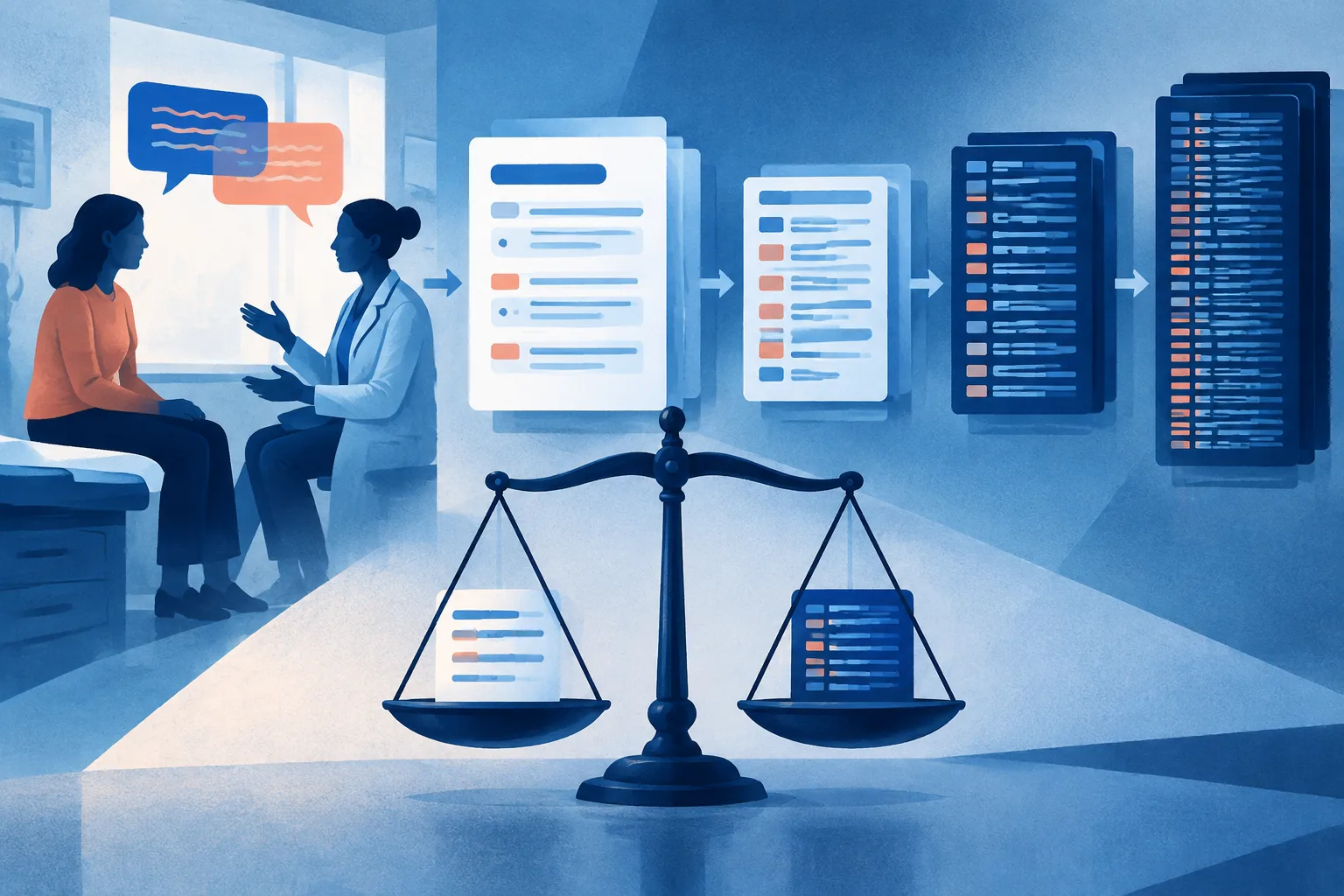
Industry materials have presented that revenue effect as a benefit. The Guardian reported that one AI medical-scribing company said its software produced an additional $13,000 in annual revenue per clinician through greater coding accuracy. A second Blue Cross report, published in September, attributed an additional $1 billion in healthcare costs over a year to AI coding. The American Hospital Association disputed the implication, arguing that the analyses identified coding trends but did not prove inaccurate hospital coding or inappropriate spending caused by AI.
Insurers are deploying algorithms too. The Guardian noted criticism that insurers use AI systems to delay or deny care, and reported that Medicare has launched a program using AI in prior authorization for some conditions. The emerging picture is therefore not a simple contest between automated collectors and vulnerable patients: providers, billing vendors, debt buyers, insurers and public programs are all adopting algorithmic tools at different stages of the same payment system.
The immediate promise is administrative efficiency—faster documentation, more consistent coding, fewer billing calls and more tailored payment offers. The unresolved issue is who benefits when those gains are applied to a system already producing widespread debt. If AI helps institutions identify what each patient is likely to pay, the technology may improve collections without resolving the underlying affordability problem. As these systems spread, transparency around coding recommendations, discount decisions and automated communications will determine whether patients experience them as assistance or as a more sophisticated collection apparatus.
Comments
Loading comments…