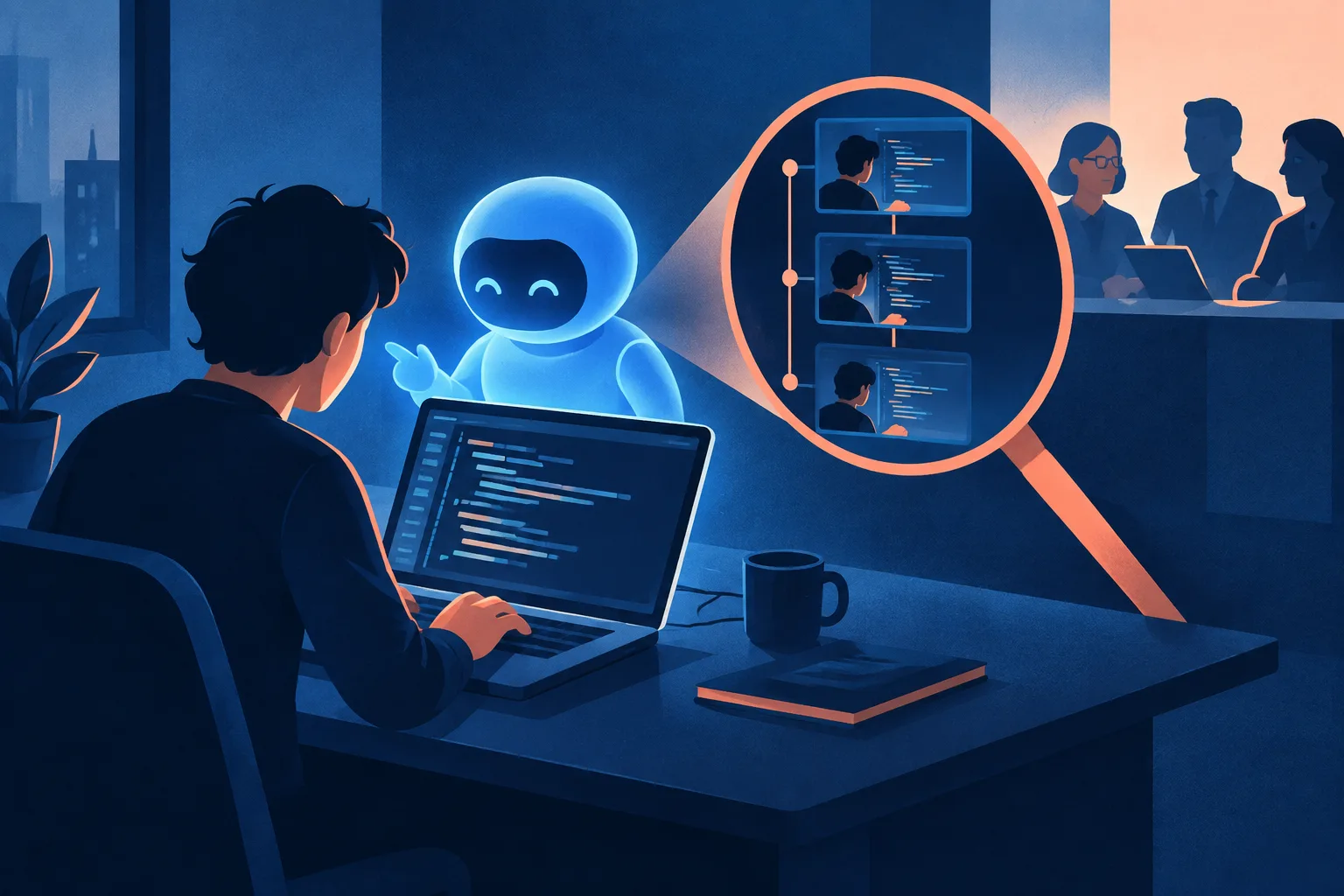
HackerRank is making its AI interviewer, Chakra, generally available after roughly six months in beta, offering employers a hiring assessment built around how candidates work rather than only whether they reach a correct answer. TechCrunch reported on October 5 that HackerRank says the agent has already conducted more than 500,000 interviews during testing, including trials involving Snowflake, Snorkel, Capgemini, and HackerRank itself.
Chakra conducts the interview, observes a candidate’s work, and evaluates the route taken to a result. HackerRank’s stated goal is to capture signals that conventional coding tests struggle to measure, including critical thinking, judgment, and what the company calls AI fluency: the ability to frame a problem for AI, assess what it returns, and guide the system toward a useful solution.
The interview is designed to resemble day-to-day engineering work more closely than a standalone coding puzzle. According to TechCrunch, candidates receive a task involving a real-world code repository and work in a canvas that includes an AI assistant. Chakra can use the candidate’s activity as context for follow-up questions, asking why a particular approach was selected or how the solution would change under a new constraint.

HackerRank CEO and co-founder Vivek Ravisankar told TechCrunch that the format can combine three stages—a recruiter screen, a take-home assessment, and a later engineer interview—into one Chakra session. That is the company’s description of the new workflow, not independent evidence that every employer will eliminate those rounds or achieve the same result.
HackerRank also says sanctioned access to AI may reduce covert assistance. Ravisankar reported that suspicious-activity flags were 70% to 80% lower in Chakra interviews than in comparable traditional HackerRank assessments, with results varying by geography and candidate seniority. The company’s explanation is that candidates have less incentive to secretly use outside answer tools when an AI assistant is already part of the test. TechCrunch did not report an independent audit of those figures.
The product marks a strategic turn for a company built around coding challenges. HackerRank, launched at TechCrunch Disrupt in 2012, now says it serves more than 3,000 business customers and has a community exceeding 30 million developers. Ravisankar’s argument is that generative AI has weakened the value of assessments focused mainly on the finished artifact, because producing an answer no longer reveals as much about the person’s underlying ability.

Chakra is intended to score candidates, not make final hiring decisions. Ravisankar said human interviewers would retain responsibility for deciding whom to hire, while the agent applies an employer’s structured criteria. He argued that a consistently applied rubric can reduce human bias, but TechCrunch cautioned that consistency alone does not make an automated system unbiased: models, data, and evaluation criteria can still carry or amplify bias.
That concern is especially important because employment decisions are regulated. TechCrunch noted that New York City requires employers using certain automated employment decision tools to arrange an independent bias audit and notify candidates before use. Ravisankar acknowledged that hiring is a regulated field and said HackerRank has had to build for compliance with such requirements.
Chakra therefore represents more than an automated interviewer. It is a test of whether employers can evaluate collaboration with AI as a job skill without quietly turning a consequential human decision over to software. HackerRank has supplied early usage numbers and internal performance claims, but the broader questions—how candidates experience the process, how reliably it measures judgment, and how employers govern its scores—remain open as the product moves beyond beta.
Comments
Loading comments…